

How the CHINESE LANGUAGE defines women
The Woman Radical
Lorraine Huang
Nu - The Woman Radical
Media: Chinese Ink on Various Papers


NU and Bisyllabic Terms
For the last 2000 years, nu, the Chinese character for woman, has been written in this form 女. This early pictograph depicted a woman in a kneeling position with arms crossed in front. Historians have generally interpreted this form as a woman in a posture of serving, or as an expression of passivity or humility. However, in light of recent archaeological finds, this kneeling position may not have reflected low status, but rather women’s labor. As we have noted, the ancient Zhou tribe believed in differentiating between the sexes, and one way was by separating male tasks from female tasks. Men who worked the fields were nan 男, made up of tien 田, “fields” and li 力, “strength or power.” The pictograph for female shows a woman on her knees doing some task at home, which at that time was likely to have been weaving.
hao - Good
Media: Chinese Ink on Various Papers.


hao,
(1) Good; well; superior; excellent
(2) Very; extremely; finished; completed
(3) To love; to be fond of
Cognate of 子 zi, child, son; 女 wife and child equals 好 good.
好心 A good heart; kind intention
好意 A good idea, good intention
好彩. Very lucky; fortunate
好久 A long time
好奇 Full of curiosity
pi - Quick Tempered
Media: Chinese Ink on Various Papers.


pi,
fang - To Hinder, To Obstruct
Media: Chinese Ink on Various Papers.


fang,
To hinder; to hamper; to obstruct; to interfere with
Phonetic from 方 fang, square, rectangular; region, point, direction; rule, method, prescription.
妨礙 to hinder; a hindrance
妨害 impair, jeopardize
妨賢 to envy worthy people; to malign the good
niao - Obscene
Media: Chinese Ink on Various Papers.


niao,
nai - Milk, the Breast, Nipples
Media: Chinese Ink on Various Papers.


nai,
mu,
lan - Lazy, Indolent
Media: Chinese Ink on Various Papers.


Other Undesirable Traits
One of the criteria for being a good wife and mother was to work industriously for the family. Passages from the Book of History stressed that women should work diligently and perform invaluable services. Sloth was condemned.
lan,
Lazy; indolent
The phonetic, 頼 lai means to rely upon another, to throw the burden upon another. Interchangeable with 懶, the more common word for lazy.
嫩 婦 The cricket
Mu - Mother, The Queen Mother of the West
Media: Chinese Ink on Various Papers.


Mu,
The most commonly used word for mother, is not listed under the woman radical but is a separate radical in itself. I have placed it here because it is actually the ancient pictograph 女 nu, with two dots for the 乳 breasts or nipples. The importance of the early appearance of this character is its reference to mother divinities and its linkage to a period when women were worshiped. The first appearance of the character mu was in a Shang oracle bone inscription which gave this forecast to the king:
"Crack-making on the ninth day; we divined: if we make offerings to the Eastern Mother and the Western Mother, there will be approval. (46)"
Fu - A Wife; A Married Woman; A Lady
Media: Chinese Ink on Various Papers.
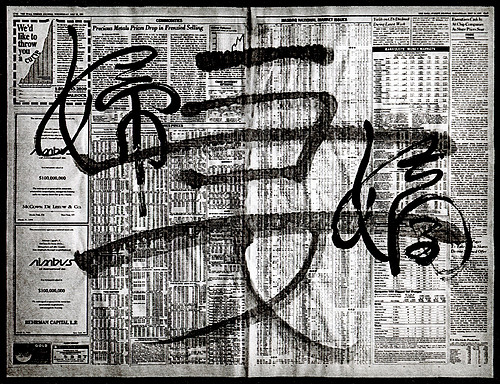


fu,
婦工 — woman’s work
婦節 — a wife’s fidelity
婦德 — female virtue
醜婦 — hag; a she-monster
qi,
(1) wife, consort of the first rank
(2) to give in marriage
Similar to preceding word. The 女 woman who in her 彐 hands holds a 屮 broom; a woman using her hands to do chores; one who is fulfilling the wifely duties.
妻子 — a wife
di,
The legal wife as opposed to a concubine Phonetic from 商 di, root, stem, base.
嫡子 — a legitimate son
嫡母 — term used by the children of a concubine to address the legal wife.
